Case study · Reacting flow · Honeywell UOP
Methane dehydrogenation reactor CFD
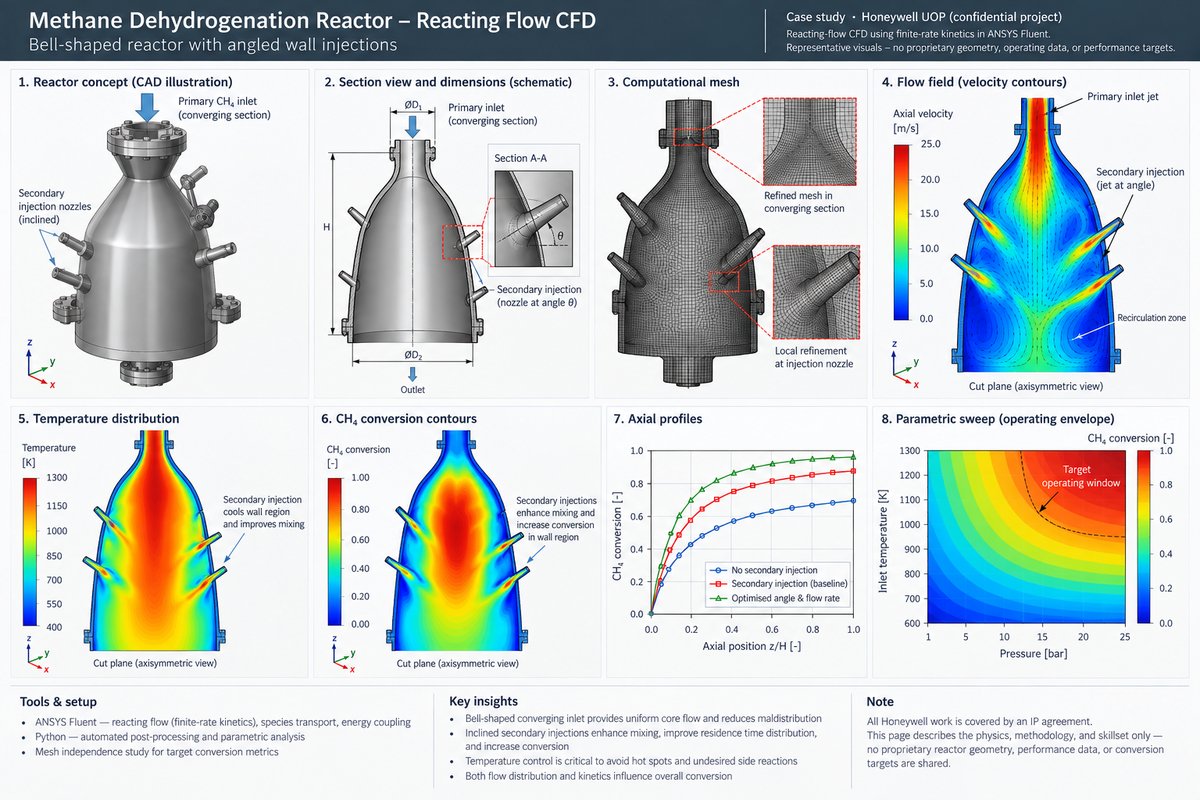
Reacting-flow CFD of a pressurised reactor — finite-rate chemical kinetics coupled with turbulent transport and species conversion in ANSYS Fluent.
Note: all Honeywell work is covered by an IP agreement. This page describes the physics, methodology, and skillset only — no proprietary reactor geometry, performance data, or conversion targets are shared.
Problem
Methane dehydrogenation is a process route to ethylene and acetylene production. The reactor operates at elevated pressure with methane as feedstock, and the design challenge is maximising conversion efficiency while managing the competing demands of residence time, temperature distribution, and flow uniformity. The team needed a reacting-flow model that could predict conversion and selectivity across the operating envelope, and identify whether flow maldistribution or kinetics was the limiting factor.
Approach
- Reacting-flow formulation — finite-rate chemical kinetics coupled with turbulent transport and species conservation in ANSYS Fluent. Multiple competing reaction pathways were modelled to capture the conversion–selectivity trade.
- Geometry & mesh — reactor inlet and distribution zone resolved to capture flow maldistribution; mesh independence confirmed for the target conversion metrics.
- Parametric sweep — inlet temperature, pressure, and residence time were varied systematically to map the operating envelope.
- Results extraction — Python post-processing of species mass fractions, velocity fields, and temperature profiles to identify recirculation zones, hot spots, and conversion-limiting regions.
Tools & setup
- ANSYS Fluent — reacting flow with finite-rate kinetics, species transport, and energy coupling.
- Python — automated extraction of conversion, selectivity, and flow uniformity metrics across the parametric sweep.
Outcomes
- Conversion mapping — identified the operating window that maximised target product yield while avoiding undesirable side reactions.
- Flow diagnostics — recirculation zones and flow maldistribution were quantified and linked to conversion losses.
- Design guidance — results fed into reactor inlet and distributor design recommendations.
Lessons learned
- Reacting-flow CFD is a three-field coupled problem — flow, species, and chemistry must converge together. Decoupling any one of them gives plausible-looking but wrong answers.
- Residence time distribution matters as much as kinetics. A reactor with perfect chemistry but poor flow uniformity underperforms.
- Mesh independence for reacting flow is harder than for inert flow — the reaction zone can be thin and easily under-resolved.
Artifacts
- Internal technical report (Honeywell proprietary — available on request with NDA).